
Design Futures India · 25 September 2026
DFI #042
In this edition: Is India is redesigning who counts as a voter?; Inside the design of India’s Election Commission; Who decides the price printed on your medicine?; and more.
-
Is India is redesigning who counts as a voter?

For decades, India’s voter roll ran on a simple default. Once your name was on it, it stayed until someone showed cause to remove it. Under SIR guidelines, the draft roll includes only those electors whose enumeration forms were received. In Maharashtra, only 78.86% of electors made it. Nationally, more than 13 crore names have been removed from draft rolls across 30 states and and Union Territories. Most states last did an intensive revision between 2002 and 2004. But the design lives in the details. In Goa, 97 voters were found eligible, but they could not be restored because the software had no option to do so. The Supreme Court asked the Commission to clarify what a “logical discrepancy” means. A form field, a matching rule, a missing button. None of these is debated in Parliament, yet each decides whose name stays. When eligibility has to be proven through lineage and data, who should carry the burden of proof?
News Source: Free Press Journal
From Design Futures India DFI #042, 25 September 2026. Read the full edition →
-
Inside the design of India’s Election Commission

The Election Commission is designed as a three-member body of equals, meant to decide unanimously or by majority. That design is a safeguard: no single hand should decide who votes. On 23 September, an Indian Express investigation found that two of those three members, Sukhbir Singh Sandhu and Vivek Joshi, had formally objected at least 14 times in ten months, in notes copied to Chief Election Commissioner Gyanesh Kumar. The objections covered deletions, the new-voter form and growing central control over the voter database. The Commission says objections are normal deliberation and every final decision was unanimous. Both claims rest on the same paper trail, and that is the design flaw. A decision stamped with the Commission’s name shows the public the outcome, never the disagreement. If a safeguard only becomes visible when a newspaper finds it, who is it protecting?
News Source: The Wire
From Design Futures India DFI #042, 25 September 2026. Read the full edition →
-
Who decides the price printed on your medicine?

On 22 September, a Supreme Court bench hearing drug-pricing petitions was told that an essential cancer medicine carried an MRP of ₹27,000 while being supplied to retailers at ₹2,700. The bench called the gap “broad daylight dacoity” and asked why the authorities responsible had stayed silent. The industry argued that manufacturers do not keep the whole margin. The court also looked at hospitals that push patients toward their in-house pharmacies, and at taxpayers paying inflated prices through government health schemes. The most important design detail came from the bench itself. When disclosure of retailer prices was proposed as a fix, the judges noted that someone buying medicine urgently would not stop to compare price lists. An MRP is really a ceiling the seller sets, a family has no power to question it. If transparency fails at the pharmacy counter, what should the system be designed around?
News Source: Bar & Bench
From Design Futures India DFI #042, 25 September 2026. Read the full edition →
-
“Design in India” says PM’s Principal Secretary

On 23 September, the Prime Minister’s Principal Secretary told a banking conclave in Mumbai that India’s journey must move from “make in India” to “design in India”. The more concrete idea came later in the speech. He called for credit to move from collateral to cash flow, with lenders judging businesses through GST returns and bank statements, and on their earnings and future potential rather than property their promoters already own. For a first-generation entrepreneur with a good business but no family land, this could open doors that collateral kept shut. But it trades one gate for another. A lender reading data can only see businesses that leave data. Informal traders, cash-first shops and women running enterprises from home may be just as invisible to an algorithm. When creditworthiness is redesigned around digital trails, who designs for the people who don’t leave one?
News Source: The Federal
From Design Futures India DFI #042, 25 September 2026. Read the full edition →
-
India standardised its fast highways. Who are they for?

On 21 September, NHAI released guidelines for the planning and design of high-speed, access-controlled National Highways other than expressways. They apply to all upcoming four- and six-lane corridors. Until now, these roads had no separate standards, and project reports varied from one corridor to the next. The new rules set lane configuration by traffic, so a corridor carrying up to 15,000 vehicles gets four lanes on a 60-metre width. They also add advance signs for exits and entries. When every project team writes its own rules, safety depends on who drew the plan. It permits entry and exit only at designated points. That serves freight and long-distance traffic well. For the farmer, the schoolchild and the cattle on either side of a 60-metre corridor, the question is where they cross. The national target is 50,000 km of such corridors. When the standard is written for the traffic passing through, who designs for the walker?
News Source: The Federal
From Design Futures India DFI #042, 25 September 2026. Read the full edition →
-
India has the chip designers. Does it own the designs?

At SEMICON India on 19 September, the IT Secretary said India accounts for nearly 20% of the world’s semiconductor design workforce, and that the government is training around 85,000 more design engineers. Four days later, the Prime Minister’s Principal Secretary told a banking conclave that the journey must move from “make in India” to “design in India”. The distance between those two statements is the story. A large design workforce into companies that own their intellectual property and sell chips globally, instead of doing engineering work for others. At the same event, a Cadence executive said the biggest cost for a chip startup is not software but people, and they remain the real shortage. Notice, too, what “design” means in all these speeches: chips and engineering, never the forms, services and systems. When “design in India” becomes national policy, who decides what counts as design, and who owns what gets designed?
News Source: The Economic Times
From Design Futures India DFI #042, 25 September 2026. Read the full edition →
-
India changed a definition, and bamboo became an economy
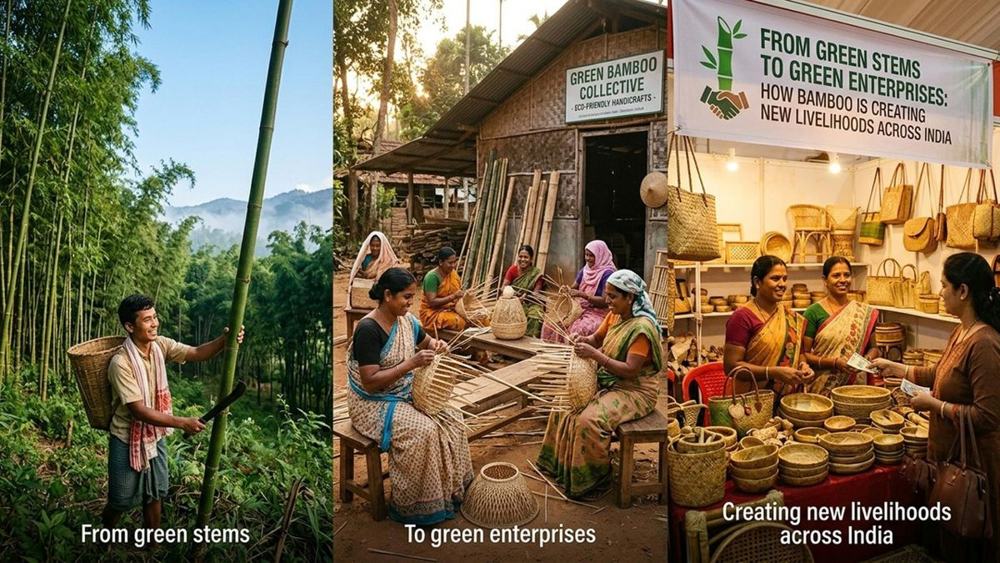
In 2017, India removed bamboo grown outside forests from the legal definition of a tree. Under the old British-era framework, that label had made harvesting and transport difficult for the communities who lived by it. The change opened space for cultivation, processing and trade, particularly in the Northeast. What followed is now visible across the country. An Assam artisan revived her family’s craft enterprise with new designs. A women-led studio near Gangtok makes furniture and décor. Engineered bamboo has built 576 school rooms in Chhattisgarh. A legal category is a design decision. Calling something a tree decides who needs permission to touch it. Definitions rarely make news, yet they quietly decide who can earn from what grows nearby. As bamboo moves from craft to industry, who keeps the value: the communities who held the knowledge, or the manufacturers who scale it?
News Source: DD News
From Design Futures India DFI #042, 25 September 2026. Read the full edition →