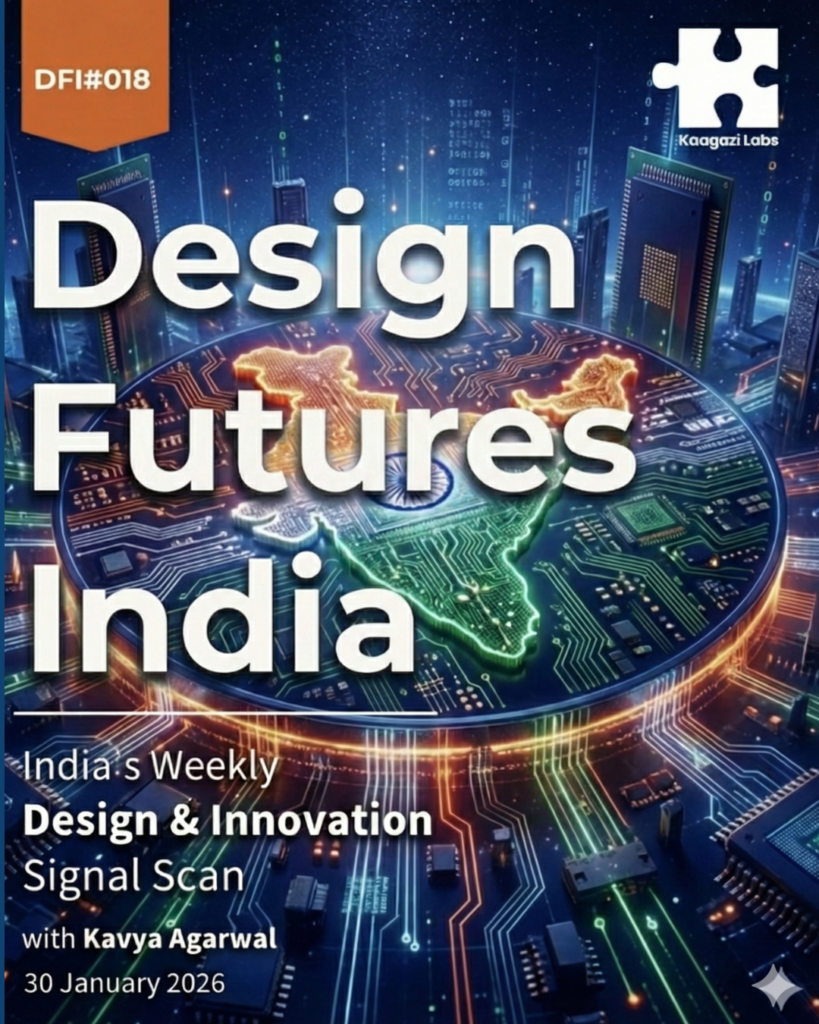
Design Futures India · 30 January 2026
DFI #018
In this edition: India Steps Back From the AI Infrastructure Arms Race; India Sets Its Sights on the Hardest Layer of Technology; DPIIT proposes amendments to the Design Act; and more.
-
India Steps Back From the AI Infrastructure Arms Race
 India’s Economic Survey 2026 carries a sharp warning. The global rush to build massive AI infrastructure, it notes, could create risks comparable to the financial excesses seen before the 2008 crisis. Concentrated investment, capitalheavy data centres, and dependence on a few global firms may expose countries to economic and strategic vulnerability. For India, this signals a deliberate design choice. Instead of chasing scale at any cost, the Survey argues for a more distributed, needbased AI approach.Shared compute, application-led innovation, and sector-specific deployment are framed as safer paths. This matters because AI is not just software. It is infrastructure that shapes power, cost, and access. India’s restraint suggests a shift from spectacle to sustainability. Designing intelligence responsibly may matter more than owning the biggest machines. Designing intelligence responsibly may matter more than owning the biggest machines.
From Design Futures India DFI #018, 30 January 2026. Read the full edition →
-
India Sets Its Sights on the Hardest Layer of Technology
 The government has said it aims to manufacture 3-nanometre semiconductor chips by 2032 and achieve self-reliance in 75 critical technology categories within four years. The announcement signals ambition across electronics, defence, telecom, and computing. What’s being tested here is not speed, but system design. Advanced chips are the most complex industrial products on earth, requiring talent pipelines, supply chains, tooling, and long- term institutional patience. Declaring targets is the easy part. Designing the ecosystem that sustains them is harder. For India, the real signal lies in whether policy, education, manufacturing, and research can move in sync. Self-reliance will not come from milestones alone. It will come from designing capability that compounds quietly over time, even when results take years to show. It will come from designing capability that compounds quietly over time, even when results take years to show.
From Design Futures India DFI #018, 30 January 2026. Read the full edition →
-
DPIIT proposes amendments to the Design Act
 India is considering long-overdue amendments to the Designs Act, signalling a reset in how industrial design is registered, protected, and enforced. The proposed changes aim to modernise definitions, speed up examination timelines, strengthen digital processes, and bring India’s design law closer to how products are actually conceived and iterated today. What’s at stake is not legal housekeeping. Design protection shapes whether originality is rewarded or copied, especially for startups and MSMEs operating on thin margins. When registration is slow or unclear, design becomes risky to invest in. Updating the Act recognises that design is no longer decorative. It is competitive infrastructure. As India pushes manufacturing, export-led growth, and product innovation, how the law treats design will quietly decide who can build, scale, and defend original ideas. As India pushes manufacturing, export-led growth, and product innovation, how the law treats design will quietly decide who can build, scale, and defend original ideas.
From Design Futures India DFI #018, 30 January 2026. Read the full edition →
-
Building Codes Begin to Design for Solar by Default
 India’s Bureau of Energy Efficiency is revising its building energy codes in a way that could significantly boost rooftop solar adoption in commercial buildings. The proposed changes integrate solar readiness directly into compliance norms, rather than treating renewable energy as an optional add-on. This is a quiet but important design shift. Building codes shape what gets built long before occupants move in. When solar is embedded at the planning stage, roofs, wiring, load management, and costs align naturally. Retrofitting later is always harder and more expensive. For India’s rapidly growing commercial real estate sector, this reframes sustainability from intent to infrastructure. Climate action here is not a behaviour change campaign. It is a design decision locked into drawings, approvals, and everyday operations. It is a design decision locked into drawings, approvals, and everyday operations.
From Design Futures India DFI #018, 30 January 2026. Read the full edition →
-
Central Vista’s Design Gaps Show Up at the Parking Lot
 Kartavya Bhavan was designed to signal a new era of governance. But a recent report highlights a quieter problem. Government staff working there are struggling with inadequate parking, forcing daily congestion, delays, and informal workarounds around a flagship public complex. This is not a minor inconvenience. It exposes a recurring design failure in Indian public projects where symbolism outpaces everyday use. Public offices are not monuments alone. They are working systems shaped by mobility, access, time, and routine. When staff movement is poorly planned, productivity drops and frustration rises. Design gaps like parking reveal how governance infrastructure often overlooks the lived experience of those who operate it daily. For India, building institutions that function well matters as much as building ones that look grand. For India, building institutions that function well matters as much as building ones that look grand.
From Design Futures India DFI #018, 30 January 2026. Read the full edition →
-
20 Years of Design discourse at Pune Design Festival
 The Pune Design Festival completes 20 years this week. Established to create a shared platform for designers, students, industry, and educators, the festival was born out of a simple need: to give India’s design community a place to meet, learn, argue, and grow together. Long before design became a buzzword, Pune Design Festival focused on practice, craft, and thinking across disciplines. Its endurance matters. Over two decades, the festival has tracked how Indian design moved from studios to systems, from products to policy, from aesthetics to responsibility. In a fragmented creative ecosystem, continuity itself is a design achievement. Spaces like this shape culture quietly, year after year. I’ll be there in person, listening in, reconnecting, and seeing what signals emerge next from a community that helped build India’s design conversation. I’ll be there in person, listening in, reconnecting, and seeing what signals emerge next from a community that helped build India’s design conversation.
From Design Futures India DFI #018, 30 January 2026. Read the full edition →
-
When India honours creativity as national infrastructure
 This Republic Day, India’s honours quietly widened their lens. Creatives like Piyush Pandey were recognised alongside artists, musicians, and cultural practitioners whose work shaped how India speaks to itself. These were not awards for spectacle, but for influence built patiently through language, emotion, and everyday cultural memory. What’s being acknowledged is not just individual excellence, but the systems creatives help sustain. Advertising, music, cinema, and craft are part of India’s narrative infrastructure. They shape trust, aspiration, and collective identity at scale. In recognising this labour, the Republic signals that design and creativity are no longer peripheral to nation-building. They are central to how a country imagines itself, communicates with its citizens, and projects soft power to the world. They are central to how a country imagines itself, communicates with its citizens, and projects soft power to the world.
From Design Futures India DFI #018, 30 January 2026. Read the full edition →