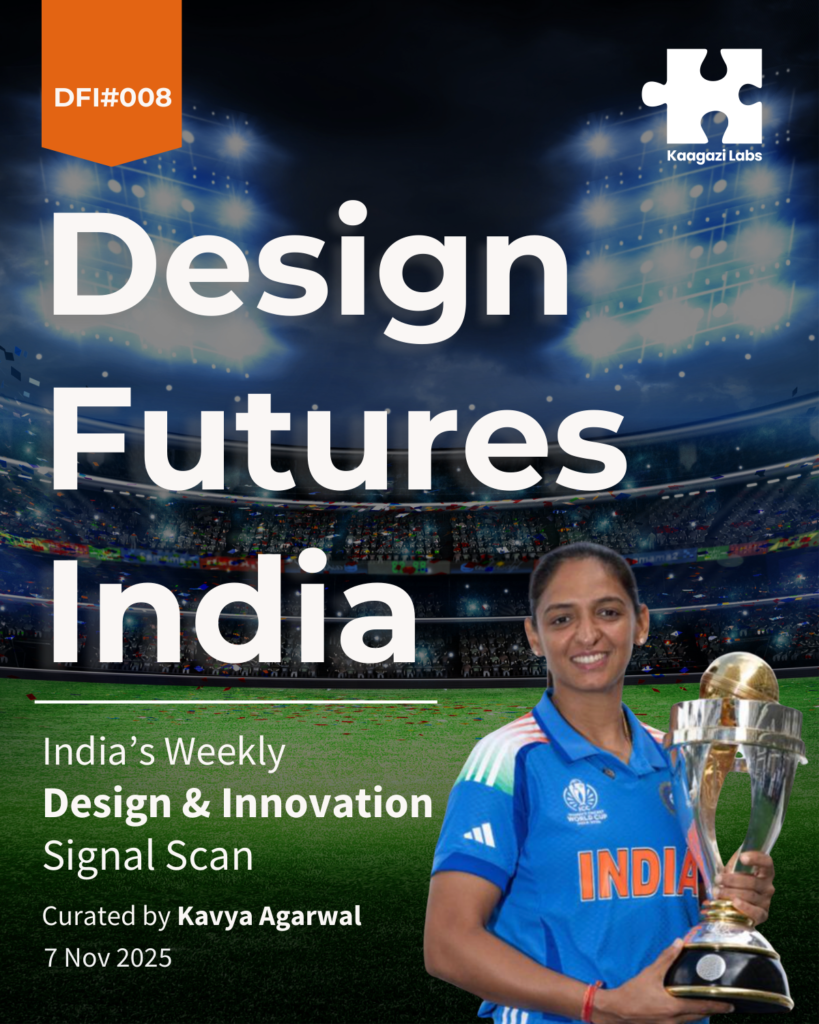
Design Futures India · 7 November 2025
DFI #008
In this edition: India’s Women Cricket Team reshapes the gender narrative; From Cowshed to Code: The Desi Canva Story; Bengaluru unveils India’s first driverless car: WIRIN; and more.
-
India’s Women Cricket Team reshapes the gender narrative
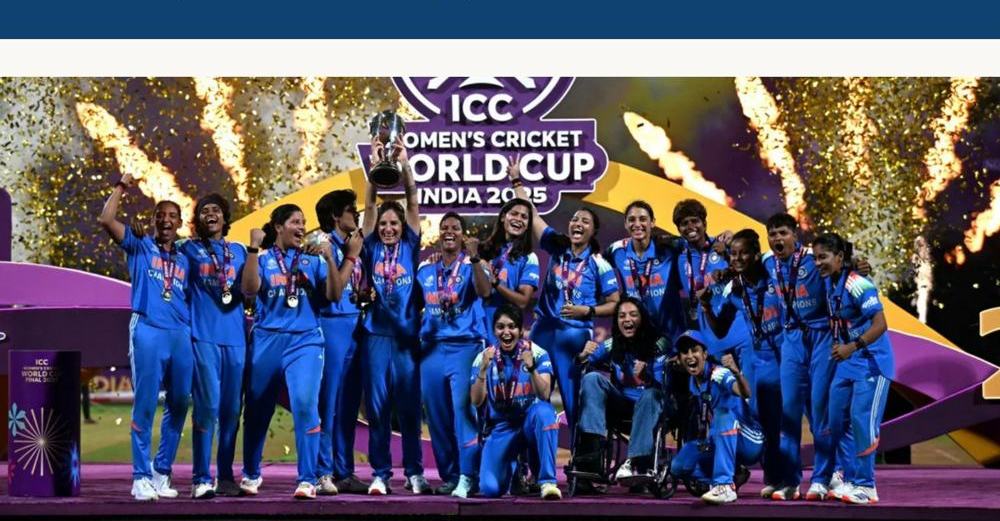 India’s women lifting their maiden ICC World Cup wasn’t just a sporting victory — they lifted the ceiling of imagination. For a billion people, gender took a backseat as the nation cheered for excellence, not expectation. Legends like Rohit Sharma and Sachin Tendulkar turned up — not as mentors, but as equals — marking a rare moment where representation stood side by side. But here’s why this story belongs here: Because moments like these show us that narratives can also be designed. In that instant, the field became a canvas of representation where optics, culture, and identity collided. This is the design of emotion and possibility —a design that will inspire millions of Indian households to believe in their daughters a little more boldly. This is the design of emotion and possibility —a design that will inspire millions of Indian households to believe in their daughters a little more boldly.
From Design Futures India DFI #008, 7 November 2025. Read the full edition →
-
From Cowshed to Code: The Desi Canva Story
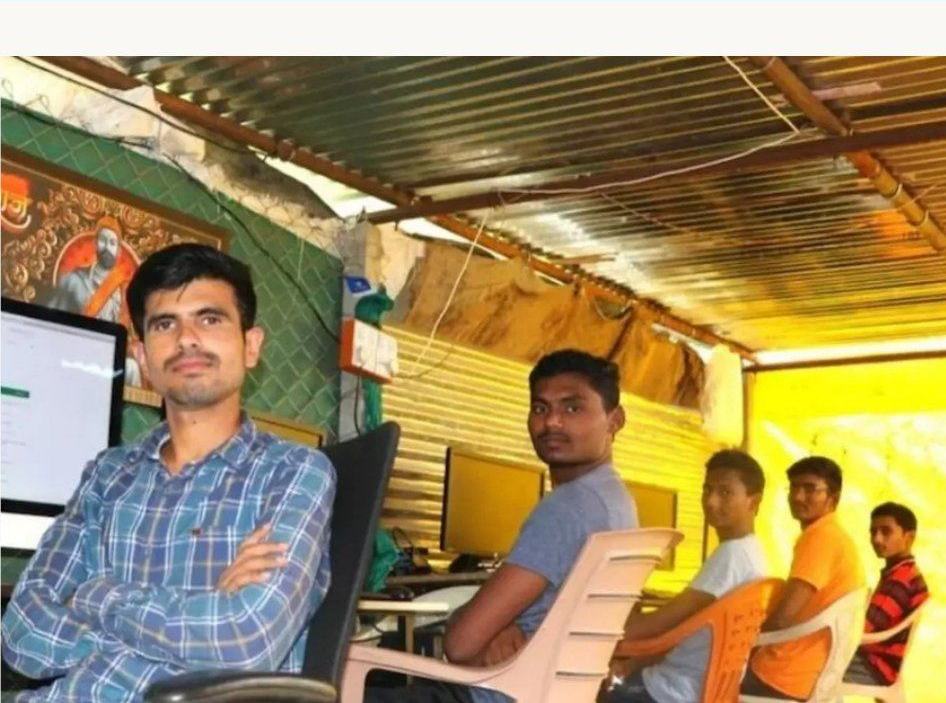 In a story that feels straight out of India’s creative future, Dadasaheb Bhagat, a 10th-pass youth from Beed district in Maharashtra, has built what media calls a “Desi Canva” — an AI-powered graphic design platform Designtemplateio Working night shifts cleaning Infosys offices in Pune to fund his dream, Bhagat began coding inside a cowshed back home — using second-hand hardware. The platform today serves over 100,000 users, many from Tier 3 and rural India, where English fluency or design software access remain barriers. What sets Bhagat apart is not just ingenuity, but empathy — designing for people like him. It’s proof that design in India is no longer a privilege — it’s a possibility for many. It’s proof that design in India is no longer a privilege — it’s a possibility for many.
From Design Futures India DFI #008, 7 November 2025. Read the full edition →
-
Bengaluru unveils India’s first driverless car: WIRIN
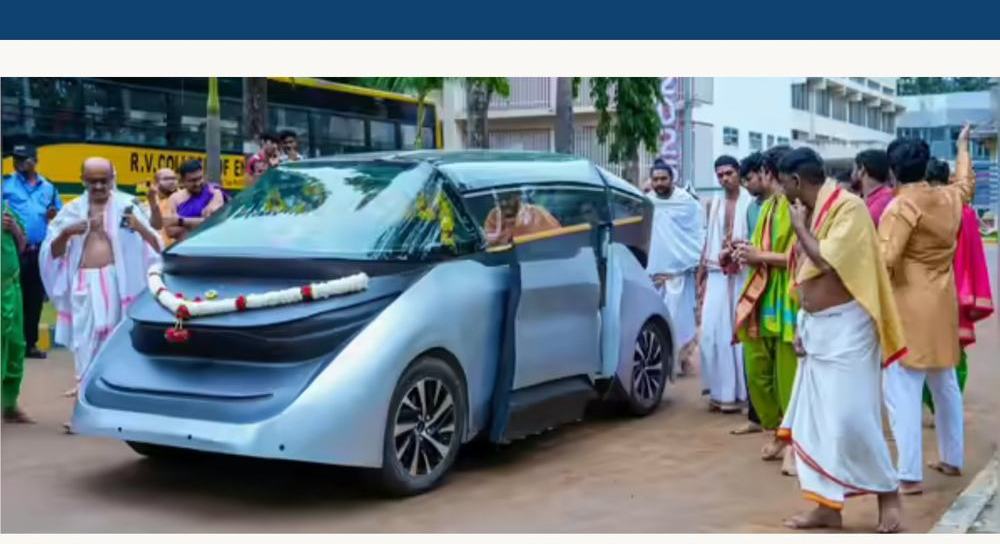 India has taken a confident leap into the future of mobility with the unveiling of WIRIN — the country’s first indigenously designed driverless car. Built in collaboration with Wipro, IISc Bengaluru, and RV College of Engineering, WIRIN integrates advanced sensors, AI-based decision systems, and design principles focused on safety, autonomy, and human experience. Unlike imported prototypes, WIRIN is designed for India’s roads, realities, and behaviours — from unpredictable traffic to diverse terrains. Its design process itself became a living lab for cocreation — bringing together researchers, engineers, and designers who had to think beyond hardware to systems, ethics, and user trust.
From Design Futures India DFI #008, 7 November 2025. Read the full edition →
-
New logo design competition: India’s Repairability Index
 India’s Department of Consumer Affairs has launched a nationwide logo design contest for its Repairability Index, inviting citizens to help design a visual identity for the country’s Right to Repair movement. The initiative aims to make repairability visible — through a symbol every consumer can recognise. The contest is open to all Indian citizens aged 16+. Entries must be submitted by 30 November 2025 (11:45 PM IST) via the mygov.in. The winning entry will receive ₹25,000 and could become the official emblem of India’s Repair Movement. The Repairability Index — and its soon-to-bedesigned logo — represent a shift from consumption to care, from ownership to stewardship. The Repairability Index — and its soon-to-bedesigned logo — represent a shift from consumption to care, from ownership to stewardship.
From Design Futures India DFI #008, 7 November 2025. Read the full edition →
-
Lucknow Joins UNESCO’s Creative Cities List
 Lucknow has been officially designated a UNESCO Creative City of Gastronomy (2025) — joining the global network of 350 cities that use creativity as a lever for sustainable development. It’s India’s first city to sit alongside culinary capitals like Lyon, Chengdu, and San Antonio. Lucknow’s culinary heritage is design thinking before design thinking — where collaboration, sustainability, storytelling, and sensory experience converge. Its bawarchis and rakabdars are designers of experience, blending craft with community, ritual with resilience. As India emerges as a creative and cultural superpower, Lucknow’s inclusion signals new confidence — that we no longer need western validation; our stories, flavours, and traditions are already world-class.
From Design Futures India DFI #008, 7 November 2025. Read the full edition →
-
University of Jammu Champions “Design Your Degree” Initiative
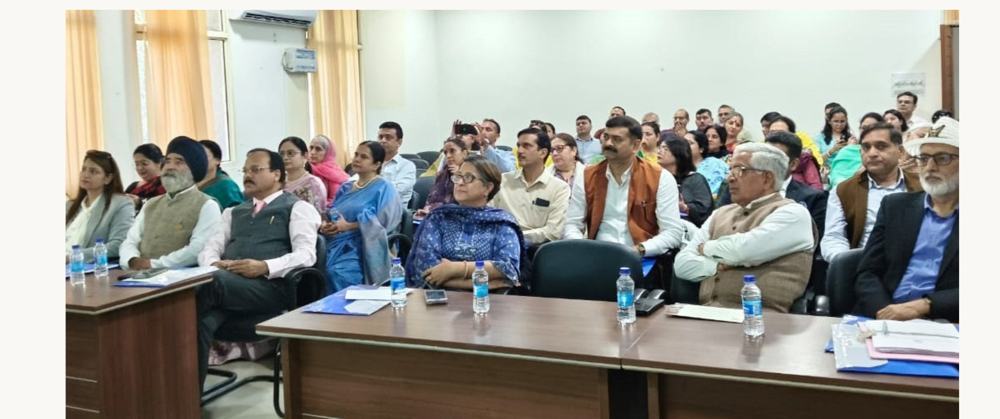 The University of Jammu held a Principals’ Meet to promote its “Design Your Degree” initiative — an NEP-aligned program that lets students customize courses across disciplines. The initiative marks a departure from rigid degree structures, placing design thinking at the heart of curriculum planning and student agency. Vice-Chancellor Prof. Umesh Rai emphasized that education reform must encourage curiosity, critical thinking, and self-directed learning — not rote specialization. When universities empower students to co-create their academic journeys, they’re teaching design in its truest sense: the ability to imagine, prototype, and iterate one’s own future.
From Design Futures India DFI #008, 7 November 2025. Read the full edition →
-
Kiran Bir Sethi — A Designer who is redefining education
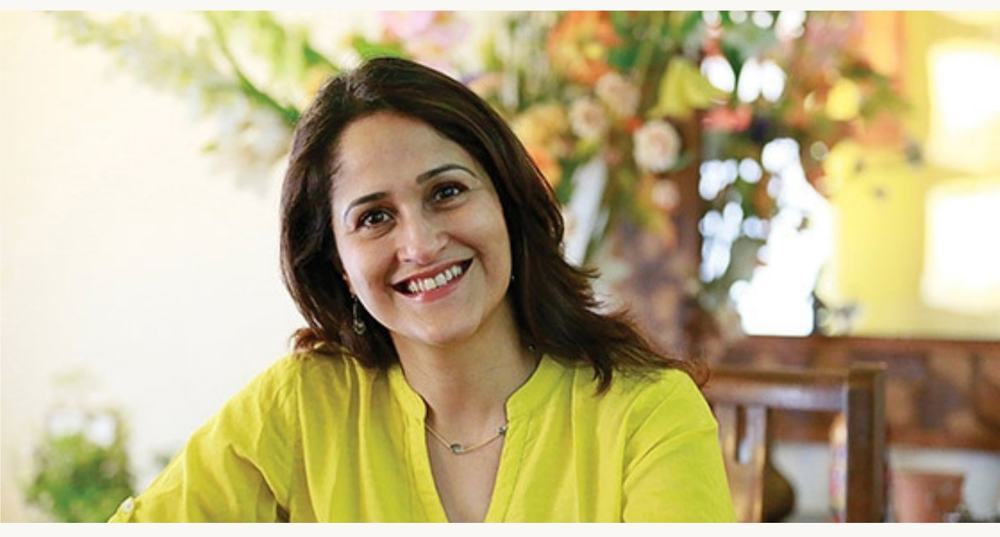 JK Lakshmipat University will felicitate Kiran Bir Sethi — designer, educator, and founder of The Riverside School — on Design Guru Day, celebrated on 9 November every year. A trained visual communicator from NID Ahmedabad, Sethi is best known for founding Riverside School — a living laboratory where design is a language for learning. Her global movement Design for Change has reached classrooms in over 60 countries, empowering millions of children as changemakers. By recognising Sethi, JKLU celebrates more than a career — it celebrates a philosophy: children build agency through empathy, imagination, and action. By recognising Sethi, JKLU celebrates more than a career — it celebrates a philosophy: children build agency through empathy, imagination, and action.
From Design Futures India DFI #008, 7 November 2025. Read the full edition →
-
Why is November 9 celebrated as Design Guru Day?
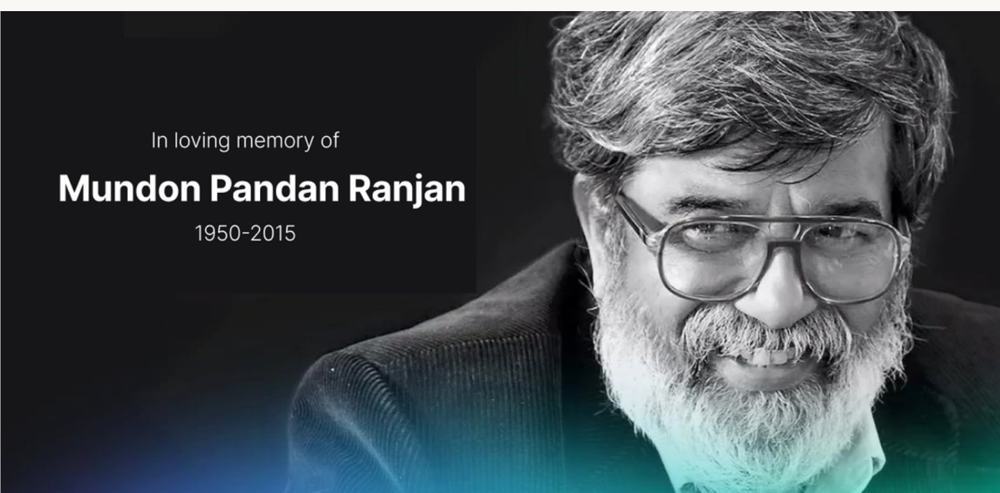 November 9 is celebrated as Design Guru Day — the birth anniversary of Prof. M. P. Ranjan, the designer, educator, and systems-thinker who taught us that design is care, craft, and community. Born in 1950 in Madras, Ranjan trained as a furniture and product designer before joining NID in the early 1970s. There, he reimagined design education — pioneering systems thinking, sustainable material exploration, and the idea that design belongs in every sector India’s economy and governance. Even though he passed away in 2015, his ideas feel more relevant than ever. As India prepares for its innovative future, Ranjan’s legacy reminds us that design is not just about creating things — it’s about shaping possibilities. Read more: design-for-india.blogspot.com Read more: design-for-india.blogspot.com
From Design Futures India DFI #008, 7 November 2025. Read the full edition →