
Design Futures India · 17 April 2026
DFI #025
In this edition: Rise of Capacilty Building as National Infrastructure; India is redesigning its governance system without calling it design; How much does India’s EV ambition depend on design?; and more.
-
Rise of Capacilty Building as National Infrastructure
 At Sādhana Saptah, the Prime Minister emphasised continuous learning, data-led decisionmaking, and breaking silos across government. Through Mission Karmayogi, governance is being reframed as an evolving capability where public servants are expected to adapt, collaborate, and improve daily, not just execute fixed roles. What’s emerging is not just capacity building — it’s system design. The state is shaping how decisions are made, how services are delivered, and how citizens are experienced at scale. India’s future public systems will depend on how well this invisible layer is designed even if it is not yet called design. to achieve this, design as a discipline cannot afford to stay narrow. Today, much of design education in India is still centred around outputs, aesthetics, or specialised roles not on shaping complex public systems, services, behaviour learning and civic participation. News Source: Press Information Bureau News Source: Press Information Bureau
From Design Futures India DFI #025, 17 April 2026. Read the full edition →
-
India is redesigning its governance system without calling it design
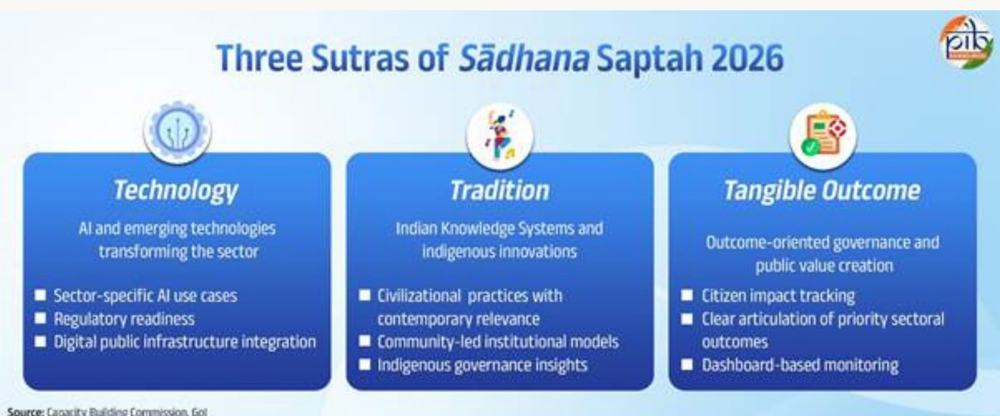 Strengthening Adaptive Development and Humane Aptitude for National Advancement (Sādhana) Saptah 2026 was organised from 2 to 8 April 2026 as one of the largest collaborative capacity building initiatives in India. It brought together over 100 Central Ministries and Departments, 36 States and Union Territories, and 250+ training institutions under Mission Karmayogi, with learning delivered at scale through the iGOT learning assessment platform. The focus is on reshaping how officials think, collaborate, and serve citizens not just what policies they implement. Public service quality is starting to depend on whether the state can train itself to be empathetic, competent, and responsive at scale. The real shift is government recognising system & behavioural design, even if it’s called “capacity building” with branding that hasn’t learned to communicate its own ambition. News Source: Press Information Bureau News Source: Press Information Bureau
From Design Futures India DFI #025, 17 April 2026. Read the full edition →
-
How much does India’s EV ambition depend on design?
 Two recent NITI Aayog reports highlight a critical gap in India’s EV push: while policy has focused on adoption, the underlying infrastructure for shared and commercial mobility remains underdeveloped. Public charging at depots, interoperable batteryswapping systems, and corridorlevel planning for trucks and buses are still missing pieces. This reveals a deeper issue — India is designing for private vehicles faster than for public systems. India’s EV transition is less a technology challenge and more a design challenge. The next phase will depend on how well invisible systems-charging networks, standards, logistics flows are coordinated at scale. Innovation here is not about better vehicles, but about designing infrastructure for shared, high-volume mobility. Once again, design is not explicitly mentioned but the real gap is exactly that: the absence of cohesive system design for India’s EV future. News Source: Business Standard News Source: Business Standard
From Design Futures India DFI #025, 17 April 2026. Read the full edition →
-
India’s drone ambitions are being slowed by how it frames safety
 India’s drone ecosystem is at a turning point. While unmanned systems globally are enabling low-cost, scalable, and rapidly deployable capabilities, India’s certification framework continues to treat them like traditional aircraft prioritising durability, long life, and nearzero risk. This creates a mismatch. Systems designed to be expendable and iterative are forced into standards meant for high-value, long-life platforms News Source: Bharatshakti.in leading to over-engineering, higher costs, and slower innovation cycles. The result is a deeper design problem. Policy is optimised for control, while the technological innovation demands flexibility, speed, rapid iteration and calculated risk. India’s edge in drones will not come from better hardware alone, but from redesigning the rules that shape how systems are built, tested, and scaled. India’s edge in drones will not come from better hardware alone, but from redesigning the rules that shape how systems are built, tested, and scaled.
From Design Futures India DFI #025, 17 April 2026. Read the full edition →
-
Ahmedabad’s metro phase 3 opens tenders for design consultancy
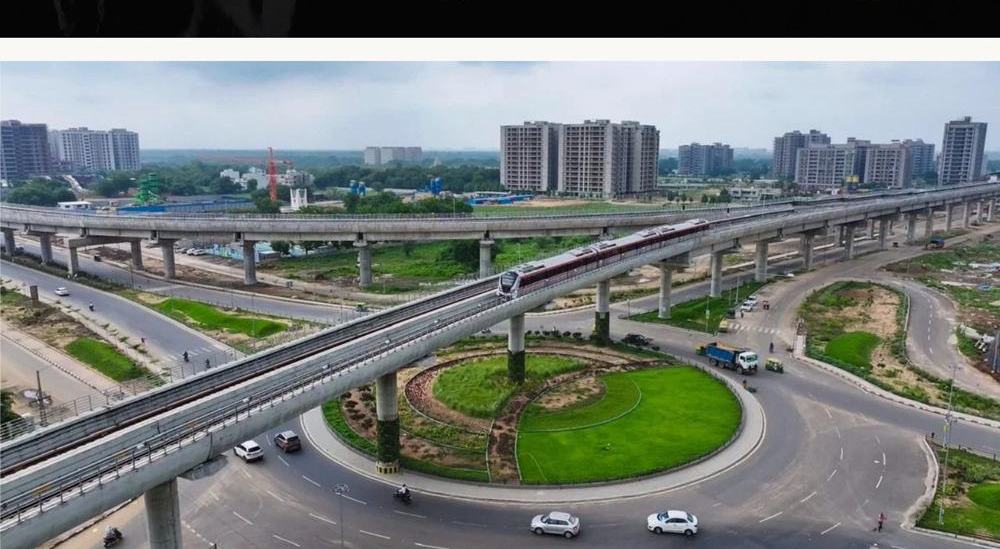 Ahmedabad Metro Phase 3A has opened tenders for detailed design consultancy across two corridors, covering 10.8 km of elevated infrastructure and 9 stations. Alongside a standard metro route, the project introduces a hybrid Metro–RRTS corridor connecting Godhavi to Canal Road signalling a shift toward integrating urban transit with regional rail networks. This is not just an expansion project. It is a design decision eyond. News Source: Metro Rail News about how cities connect within themselves and beyond. The real shift lies in thinking of mobility as a continuous system, not fragmented modes. Designing shared corridors for metro and rapid rail begins to blur the boundary between city commute and intercity movement. India’s urban future will depend on how early these urban-level design choices are made — long before concrete is poured. India’s urban future will depend on how early these urban-level design choices are made — long before concrete is poured.
From Design Futures India DFI #025, 17 April 2026. Read the full edition →
-
India is introducing AI in classrooms but the curriculum question is bigger
 Union Minister for Education, Shri Dharmendra Pradhan, has recently launched a new CBSE curriculum on Computational Thinking and Artificial Intelligence for students from Classes III to VIII. The aim is to build early familiarity with problem-solving, logic, and responsible use of emerging technologies making AI part of foundational education rather than a specialised skill. This signals a shift in how India is preparing its next generation not just as users of technology, but as thinkers within it. However, the deeper gap is in learning design itself. This is not just about adding a subject, but about rethinking how children engage with systems, data, and decision-making from an early age. The real work lies in designing learning that builds judgment, responsibility, ethics and agency, not just technical skill for India’s advanced future. News Source: Press Information Bureau News Source: Press Information Bureau
From Design Futures India DFI #025, 17 April 2026. Read the full edition →
-
85% of the workforce, 0% of the system: India’s invisible farmers
 India’s agri-tech push is accelerating, with investments in AI-driven advisory systems, precision farming, and data-led productivity. But beneath this optimism lies a structural blind spot: women farmers, who form nearly 85% of the rural agricultural workforce, remain largely invisible in formal systems. Because access to digital platforms is tied to land ownership, identity records, and device access, many women are News Source: Down to Earth excluded by default. The result is a system that modernises agriculture without recognising the people sustaining it. This is not a technology gap, it is an inclusion gap. When data, platforms, and policies are built on incomplete realities and gender biases, they reproduce inequality at scale. The real challenge is designing systems that include those historically left out yet ironically are the backbone of this country. The real challenge is designing systems that include those historically left out yet ironically are the backbone of this country.
From Design Futures India DFI #025, 17 April 2026. Read the full edition →